People and languages
- India is the world’s most populous country. It passed China in 2023, according to UN estimates.
- India’s constitution recognises 22 scheduled languages, and hundreds more are spoken.
- Hindi and English are used by the central government. Most states also have their own official language.
- The whole country runs on one time zone, IST, which is 5 hours 30 minutes ahead of UTC.
- India drives on the left.
Ideas the world borrowed
- Chess grew out of an Indian game called chaturanga.
- Snakes and ladders comes from an old Indian game about virtue and vice.
- The rules for zero as a number were written down by the mathematician Brahmagupta in the 7th century.
- The word shampoo comes from the Hindi champo, a head massage.
- Yoga began in India. The UN made 21 June the International Day of Yoga.
Nature
- Mawsynram and Cherrapunji (Sohra) in Meghalaya are among the wettest places on Earth.
- Meghalaya’s living root bridges are grown from the roots of rubber fig trees over many years.
- India is home to most of the world’s wild tigers.
- Kaziranga in Assam protects about two-thirds of the world’s greater one-horned rhinos.
- The Thar Desert in Rajasthan and the salt desert of Kutch are both in India, and so are some of the world’s highest mountains.
- India’s coastline is more than 11,000 km long by the government’s latest measurement, which counts the islands in much finer detail than the old figure of about 7,500 km.
- Ladakh is a high-altitude desert. Leh sits at about 3,500 metres.
Places
- India has 45 UNESCO World Heritage Sites, after Sarnath was added in July 2026.
- Srinagar has a floating post office on a houseboat on Dal Lake.
- Chail in Himachal Pradesh has a cricket ground often described as one of the highest in the world.
- The Golden Temple’s free kitchen feeds tens of thousands of people every day, whoever they are.
- The Kumbh Mela is one of the largest gatherings of people on Earth, and is on UNESCO’s list of intangible heritage.
- Kolkata’s Howrah Bridge is a cantilever bridge built without nuts and bolts. It is riveted.
- Mumbai’s Chhatrapati Shivaji Maharaj Terminus is a working railway station and a World Heritage Site.
Food
- India produces more milk than any other country.
- Chillies came to India from the Americas, probably with Portuguese traders. Today India is one of the biggest chilli producers in the world.
- India grows a huge share of the world’s spices, from pepper and cardamom in Kerala to saffron in Kashmir.
- Darjeeling tea has a protected geographical indication, like Champagne.
- Many states have their own thali, a full meal of small dishes on one plate.
- Tea became an everyday drink in India only in the 20th century.
Festivals and culture
- Diwali, the festival of lights, is celebrated by Hindus, Sikhs and Jains, and many others join in.
- Holi is the festival of colours, marking the arrival of spring.
- Durga Puja in Kolkata is on UNESCO’s list of intangible heritage.
- India makes more films than any other country, in many languages, not only in Mumbai.
- Cricket is followed with something close to religious devotion.
Travel
- Indian Railways is one of the largest rail networks in the world.
- Three of India’s mountain railways (Darjeeling, Nilgiri and Kalka-Shimla) are together a World Heritage Site.
- You can go from snow in Ladakh to the beaches of Kerala in the same month.
- Foreign visitors from most countries can get an e-Visa online.
- There’s a best place to visit in India for every month of the year. Try our month planner.
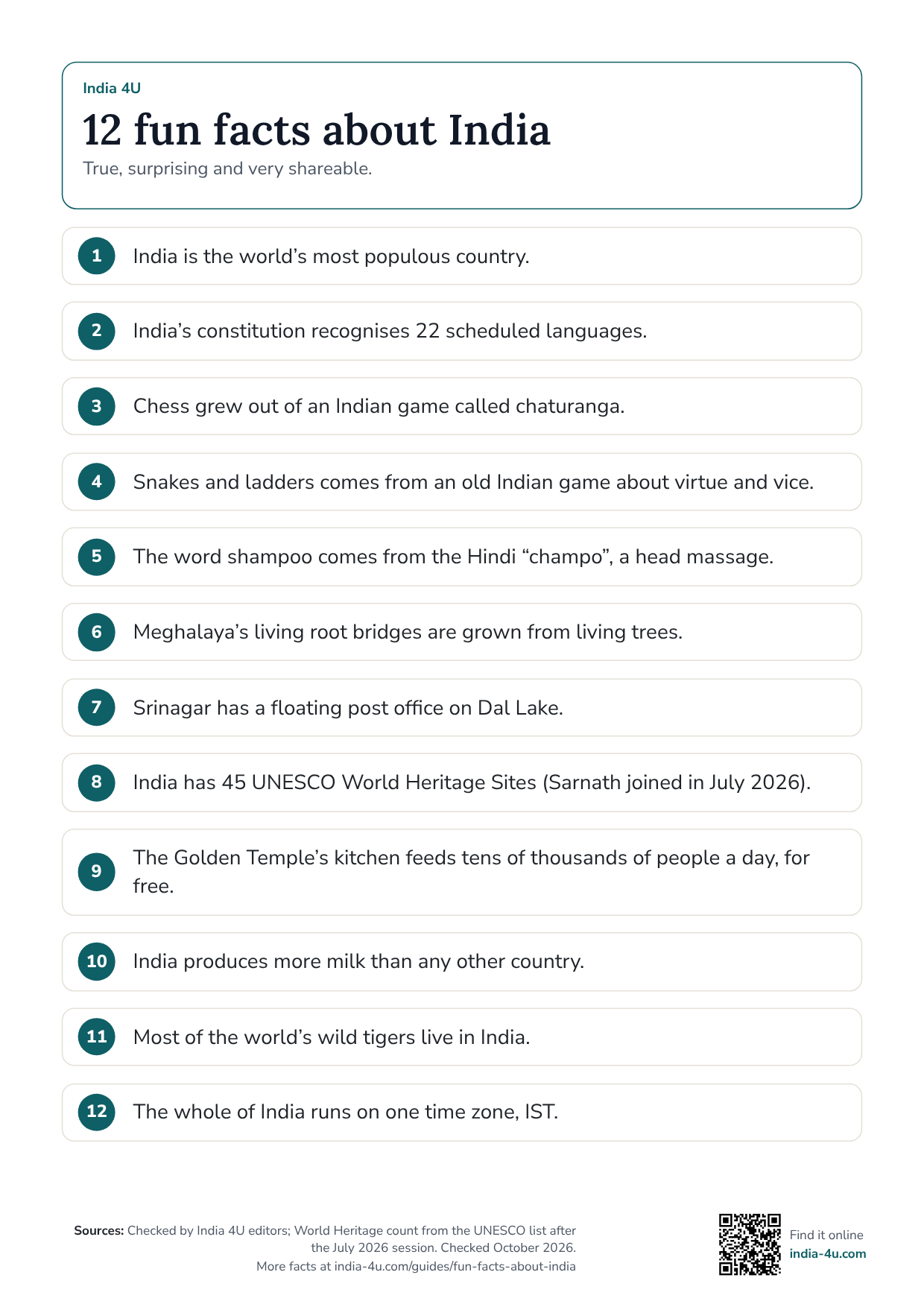
Want these as a printable or a shareable image? See printables.
Free printable: download 12 of these as a poster as a PDF or image. More on our printables page.